
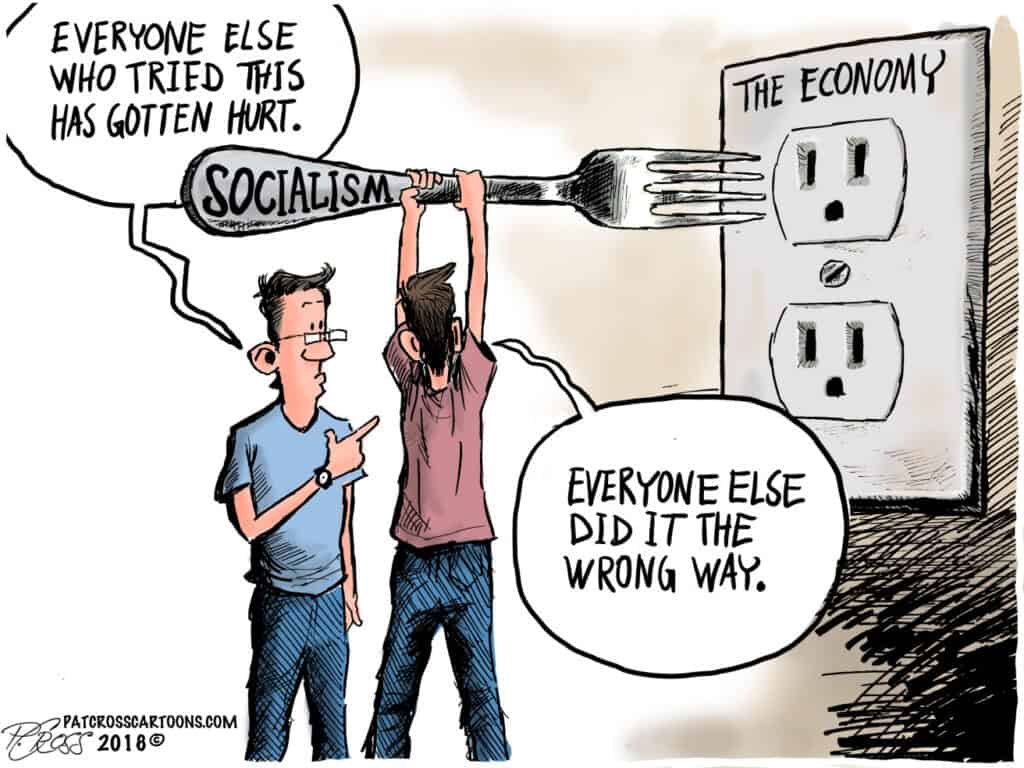
The problems of Socialist policies
Many people seem to have forgotten that Socialism, as an economical and political doctrine, has been condemned by the Catholic Church, even the “moderate” or “tempered” forms of Socialism. This is mostly the effect of the “Novus Ordo Church” practically endorsing Socialist beliefs and promoting Socialist leaders, to the point that the general public assumes that the correct Catholic stance is to support the Socialist policies of modern Western governments, in particular the so-called “welfare state.”
But it could also be the effect of a mistaken idea of charity and community life: some people have a favorable opinion of Socialist policies, because of their “social” nature; it sounds good to give money to help people in such and such circumstances of their lives, it sounds charitable. It sounds good to have a lot of affordable public services available even to the most disowned citizens.
Yet, there’s a good reason why the Church warned against these doctrines. It sounds good, but like many other false doctrines, it is good only on paper, and has been proven to have bad effects on the overall society, making the life of most people effectively worse than in the scenario in which the state is less involved in everyday life.
We wanted to provide here a few key principles and few examples to illustrate how reason alone, often confirmed by the magisterium of the Church, rejects the Socialist policies and the Socialist-leaning views so commonly held across the Western world.
1- The Family is the most fundamental institution of society, not the State
Our societies are living through such a dramatic breakdown of the family that most people have forgotten this common sense, universal principle, which is that the most fundamental institution of human life, the most fundamental institution of society as a whole is the family.
It is the family which ought to provide for the individual’s basic needs, in case they are unable to provide for themselves: it is especially the case for the children, but also the sick and the elderly, the one who is hit by misfortune. In case someone becomes an orphan, there should be some uncle or cousin ready to take care of them.
Nothing can replace the natural fraternity and solidarity created by blood ties. The love of a mother for her children is not replaceable with some impersonal governmental care. Kinship has always been and will always be a stronger unifying force than any political ideology. The more a nation’s identity is based on ancestral kinship, the stronger and the more unified it is.
Since the family existed prior to the State, and is much more fundamental to human life than the State could ever be, it is a common sense truth that the State should not in any way hinder the natural functioning of the family.
The #1 job of the State is to provide the conditions necessary for families to thrive. That is the end goal of all of its traditional functions: justice, police, defense, diplomacy, money minting, administration and law. All these functions aim at maintaining or encouraging peace, security, morality, and prosperity. The more statesmen are focused on this core mission, caring about providing the conditions for ordinary citizens to provide for their basic needs and for their families, the more respected and loved they will be by the people. This is true no matter what the form of the government is: a kingdom, a dictatorship, a direct democracy, an aristocratic regime, a regime of elected representatives…the people are blind to the form of government, as long as it provides peace, security, prosperity, and justice. Trouble begins only when the regime is not properly carrying out these essential functions.
The State exists to serve the people, not the reverse. This may sound like the way left-leaning politicians present the welfare state, but it really isn’t the case: you are not “serving” the people when you forcefully collect half of the wealth it produces, to do undetermined things with it, and only partially give it back in some indirect and very delayed ways.
Only when the family has failed, only as a last resort, should the State intervene to help the individuals meet their basic needs (food, clothing, shelter). Even before reaching this last end, local and private institutions can and should intervene to help individuals and families in extreme need — as it was done before the invention of the welfare state. Relying on the State should not be the default way of handling life’s hazards: this attitude comes with very negative consequences, as we will see later. Instead of trying to replace the natural role of the family, the State should rather 1) encourage and protect the institution of the family in itself, 2) provide the legal and economical conditions necessary for families to thrive.
We can’t help but notice that all modern “social democracies” and “welfare states” combine their benevolent welfare policies with aggressively anti-family policies: promoting birth control and abortion, legalizing adultery, divorce, pornography, and all kinds of debaucheries; giving extraordinary benefits to single mothers — which clearly constitutes an incentive for being single instead of being married; promoting the public school system to the point of saying it has more power over the children than the parents have. With the growing rate of out-of-wedlock births, divorces, voluntary or involuntary celibacy, and childlessness, Western societies are becoming more and more familyless societies. The welfare state, with its excessively generous policies (which makes the need for marriage, for a strong family and a strong local community less relevant), combined with anti-family legislation, is largely responsible for this breakdown of the family.
2- High taxation is a sin against justice
The right to possess private property is derived from nature, not from man; and the State has the right to control its use in the interests of the public good alone, but by no means to absorb it altogether. The State would therefore be unjust and cruel if under the name of taxation it were to deprive the private owner of more than is fair. — Rerum Novarum, 47.
If you are not convinced that the welfare state is a threat to social order and has bad effects on society, consider this: there is no “welfare state” without a very high tax rate. The more you want the State to take care of such and such problems, the more taxes you are imposing on ordinary working people.
It is a violation of justice to forcefully take a high proportion of one's salary, no matter what is done with it afterwards. The fact that we receive in exchange some “redistribution” is not enough to justify this deprivation of one’s legitimate income.
If you agree that taxes are too high, and also think the welfare state is great, you may be holding contradicting views.
The only case in which a welfare state could exist without high taxation would be a case where the state has an autonomous source of revenue which exceeds the public funding needed to make it function: Norway is an example, with their petroleum and huge sovereign investment fund. It makes their system more interesting, less broken and dysfunctional than that of France or Canada (even though the problems inherent to socialist policies remain). But most countries don’t have the opportunity to fund welfare policies through such autonomous profits. They have to draw on the profits generated by businesses and individuals.
If you think taxes should be lower for the average working man, but higher for the rich and for the businesses, you may not understand the bad side effects of such policies on the overall society. Such a policy would rather lead to a decrease in public revenue instead of an increase, for various reasons:
- Taxing small businesses might be, in many cases, a threat to their very existence. A very high taxation for small businesses means there’s no incentive to quit a regular job and start a business of your own. So you’ll accept making less money having a regular job, instead of making more money (and paying more taxes — that’s where the public revenue decreases) if there’s nothing left for you after the tax declaration.
- More taxes for big businesses: sounds good and smart only to people who have no understanding of economics whatsoever. It could mean decreasing the value of their stocks — upon which the value of your retirement pension may depend. It could mean layoffs, recruitment slowdowns, worse schedules and work pace for the employees, relocations, less investments, etc.. in other words, a general slowdown of the economy and worsening of work conditions for everyone, including employees. If you have experienced both working in a business that has a lot of money, and working in a business which is financially in the red, there’s a good chance you were much better as an employee in the first scenario. If businesses are less active and less innovative, they will be less profitable: therefore, there will be less money left to tax, that is why public revenue will not increase even though the tax rate has.
- Successful tax-paying businesses that operate on an international level are likely to relocate somewhere else if the tax rate is too high in their country. Countries with moderate tax rates (such as Ireland) have experienced a spectacular boom in public revenue. That means other countries have experienced a loss.
- More taxes for the super-rich: they’ll find a way not to pay. These people have access to the best lawyers, financial advisers and accountants of the world. Politicians who say they’ll add additional taxes for the super-rich are demagogues. They’re not solving any problem.
No matter what, it is fundamentally a sin against justice, an “unjust and cruel” thing to forcefully take half of the rich man’s legitimate income or property in order to fund welfare policies.
3- What is held in common is neglected
Men always work harder and more readily when they work on that which belongs to them — Rerum Novarum, 47.
Socialists, therefore, by endeavoring to transfer the possessions of individuals to the community at large, strike at the interests of every wage-earner, since they would deprive him of the liberty of disposing of his wages, and thereby of all hope and possibility of increasing his resources and of bettering his condition in life. — Rerum Novarum, 5.
It is a general law of human nature that we will care much more for what is ours, compared to what is shared or what belongs to no one in particular. It comes down to what Aristotle said:
That which is common to the greatest number gets the least amount of care. Men pay most attention to what is their own: they care less for what is common. — Politics.
It is impossible to “reform” through education or policies, that core drive which is hard-wired in our nature. No matter the brainwash and the indoctrination, people will work more and better if they see that their work directly benefits them and the people they love the most, while the perspective of working for “society” or for “the poor” will almost certainly not arouse the same kind of motivation. It rather has the potential to break one’s mind: you cannot measure the good you do to “society,” because you are such a small part of it that your actions have practically no impact on it. You feel useless and insignificant among this enormous mass of people. However, you can measure your usefulness very directly when your work improves your family’s quality of life in a tangible way.
This is not selfishness, heartlessness, or greed. This is just how God willed human nature to be: we ought to care the most for what is closest to us, that is ourselves and our relatives. We ought to have a general charitable attitude towards all other human beings, but we physically cannot care for all these people as much as we would care for a wife, a son or a daughter.
A society which does not respect this basic reality will not flourish.
Having to “work for society,” for something so big and so vague, is basically slave work. You might as well be a slave working for a master who gets to rip most of the benefits of your work, while giving you the bare minimum in return. That which belongs to your master does not belong to you: hence, you don’t care that much about the quality of your work, if it was not for the fear of punishment. Abstractly speaking, the slave may know that his personal well-being depends on the overall success of his master’s business: but this abstract consideration is not enough to arouse motivation. It seems that even in the context of slavery, some smart masters were incentivizing their slaves to work better by giving them an actual salary, and with that the perspective to buy their own freedom one day.
These slave owners had a better understanding of human nature than left-leaning politicians, constantly working at increasing the taxes, and calling everyone “selfish” because they are not enthusiastic about “working for society.” It is rather certain that society would be in a better shape if people were focused on improving their situation and that of their family, instead of “working for society” in a vague and general sense: the history of communist countries is quite telling in that regard.
4- Endless giving without reciprocation leads to entitlement
The modern world has developed mistaken ideas about generosity, charity and service. The modern conception of “unconditional love” has gone too far: it has caused people to reject the notion of Hell, which appears contradictory with “God’s unconditional love.” It has caused many parents to reject the notion of command and punishment, as they would imply that the child has to behave in a certain way to deserve the love of his parents.
It is good and natural to expect some kind of reciprocity, when one gives out of love: love calls for love, a gift calls for a counter gift. Generosity means we expect less than what we give, we do not care much about what we receive in return. But it is impossible to accept a total lack of gratitude from the people towards which we are generous. The generous person who gives a lot and receives absolutely nothing in return will end up ceasing to be generous at some point, or directing his generosity towards a better object.
God gives a lot, and only expects little from us in comparison. But when His gifts and His calls of love are continually rejected, he ends up punishing us. That does not mean His love is not infinite: we should rather understand that the more one loves, the more one deserves to be loved in return at least to some extent, and cannot stand a total lack of reciprocity forever.
What happens when one receives a lot of gifts, a lot of benefits, without being expected to give anything at all in return? What happens when this takes place on a regular basis, and becomes a habit of receiving without owing nothing? In the case of a child, in relation to his parents, he becomes what we call a spoiled child.
Excessive generosity, that is totally disconnected from justice, can only have bad consequences.
Excessive generosity in the case of the welfare state, creates a whole class of spoiled children, forever demanding new benefits, forever expecting society to take care of them, and being expected to give nothing in return.
Growing up in France, I cannot remember how many times I have heard people being angry at the State for not giving them enough, while these people already have most of their life funded by taxpayers money (public housing, public medical insurance, public school, public transportation, public unemployment insurance; and in many cases, they also have a job created by public institutions, and are more or less directly employees of the State). It has become a habit and a custom to complain about how little we receive from the State, and the more people receive, the more they complain. It has become a given for half of the French society that everything in our lives ought to be handled by the State, while the other half of society is taxed in order to fund these policies. This could not better illustrate the “giving without reciprocation” principle: people coming to France to benefit from her welfare policies only hate her and despise her more. Because we give without expecting anything in return, we appear as a weak people, easy to be taken advantage of.
This does no good to society.
5- Redistribution policies give an excessive power to the State
On paper, it sounds fair to give a lot of money through taxes, if in return we receive a lot of services and benefits. That is basically how left-leaning policies are sold to the common people tired of paying so many taxes: “don’t worry, this will improve your life in some way later.” It sounds kind of fair, on paper; but what is the problem, then? Why has the Catholic Church warned against the development of these Socialist policies?
Part of the answer is that the Church was always worried that the powerful, the statesman, may take too much control over society. The Church, through the ages, has fought vehemently against the State’s interference with Her own internal affairs. When the massive modern states started to develop, the Church firmly fought against the interference of these massive states in family life and education.
When a society chooses to give half of its wealth to the State, in the hope of being given back some benefits later in return, it is not merely signing up for the later benefits. It is signing up for giving, right now, an immense and terrific power to the state officials in charge of managing its money. Since they are in a position of power, and since they are in a position not to explain exactly how the money is used, it is hard to expect any serious accountability on their part. They can basically do whatever they want, and the society will bear the consequences of their bad decisions later.
Facing such a massive and complex system, only a few educated citizens could truly understand if there are serious mismanagement issues, and they are not numerous enough to sanction a faulty government through their vote; the mass of people on the other hand will tend to fall under the appeal of short-term public welfare policies, while not caring about the long-term consequences.
Experience tends to show that the more money and power government officials have, the less likely they are to care about common good, carry out policies that actually improve people’s life, and carry them in an efficient and sensible way. In a country like France, which has the highest or second highest Tax-to-GDP ratio in the world (an astounding 43.8% in 2023), public spending and public debt have increased to an alarming rate, putting the stability of the country at major risk. Yes, you’ve read it well: the government in the world which has the highest revenue, and the highest power compared to its people’s wealth, is spending more money than it has and is crippling in debt. That is a systemic failure.
6- Redistribution policies incentivize laziness and immorality
The current “welfare state” has little to do with the genuine concern of alleviating misery and providing help to people in desperate situations, to the widows and orphans hit by misfortune. This huge system has grown out of control and produces a series of bad consequences.
It has become a way to:
- Avoid the bad consequences of one’s own bad behaviors. People who behave badly should experience the consequences of their behaviors. It’s a matter of justice, and to some extent a matter of charity: there’s a chance the bad person repents when he sees how terrible the consequences of his behavior are. Many of the risks or “problems” the welfare state is taking care of are not some kind of dramatic twist of fate, some innocent people struck by misfortune. Indeed, some people live carelessly, don’t save anything and even go into debt for silly motives: government benefits allow them not to think about their future and behave more prudently.
- Avoid work. Western welfare has inaugurated something which is probably unheard of in the whole human history: it is possible for ordinary people to survive without working. This used to be possible only for the super-wealthy. Now, everyone could pretty much choose not to perform any kind of work, and still manage to survive. Since that is an option — it definitely is in France, for example — there is not the same incentive to work hard, or to work at all. Aside from the extreme case of people who chose to do nothing, the population in general is not working as much and as well as it used to. Instead of working more, people will just do the bare minimum to get a steady paycheck, enough to get by, and rely on welfare for more important issues.
The tax-funded welfare system often ends up in this absurd situation: a class of working people is ripped off from the benefit of its work, which is mostly distributed to an ever-growing class of non-working people. In the meantime, a class of super-wealthy citizens finds legal or illegal ways to get around most taxes, which makes the situation even more absurd: the “redistribution” is not so much “from the rich to the poor” as we would like to think it is, but from the middle class or working class to an unproductive class of dysfunctional and criminally inclined individuals.
Indeed, only people who happen not to work (which is more often than not a choice and a calculation, because it makes sense to take free benefits without having to do anything, instead of receiving a low wage with a tedious job) truly benefit from the system: people who work hard could autonomously handle most if not all of the problems the State is supposedly solving with welfare, if the tax rate was lower and if they were managing their finances prudently.
Moreover, countries with extensive welfare policies usually suffer from a terrific rate of “social fraud,” from people abusing the system and receiving benefits they are not legally allowed to receive. Little to nothing is done to remedy this problem, since in the leftist worldview, people who commit social fraud are desperate people who need help anyways. According to conservative estimates, social fraud in France amounts to €50 billion a year — that is more than the budget of the French army! This is mind-boggling. I still can’t wrap my head around that figure.
On the opposite side of the issue, what does this system produce for people who 1) work hard, 2) manage their finances prudently, 3) try to lead overall a honest and moral life, 4) are willing to take risks and make extra efforts to improve their lives and the life of others around them — what happens for these kind of people?
They become:
- Discouraged. Nobody is encouraged by the perspective of diminishing rewards. The current tax system in most Western countries is designed to take more and more money from someone as he becomes more successful and/or takes more risk. Since risk and effort are effectively punished, instead of being rewarded, it logically creates a stronger risk aversion in the general population.
- Angry. A growing anger is rising among the middle class which supports the costs of the welfare policies, and suffers from its bad consequences (mass immigration being the No. 1 issue, as the growing vote for “far right nationalists” all across Western countries shows).
For a society to thrive, it needs to encourage these kinds of people, and create more of them, instead of discouraging them.
This being said, on an individual level, it should still be advised to fight against discouragement, bitterness and anger: we don’t want anyone to read this, and be comforted in his view that “the system is rigged, it’s too bad, there’s nothing I can do.” We should rather see these failures and these injustices as a personal challenge: how are you going to thrive in spite of all that? How are you going to get around that, and make your way in the world? It’s more difficult than it should be, but not impossible. There’s an analogy to be made with the moral and spiritual state of the world, and our personal spiritual lives: the debauchery and decadence that surrounds us is certainly something very bad that should not exist; yet, it is an occasion to practice heroic virtue. Isn’t it exciting to carry on faith and virtue, in a world where everything is designed to make us fail in that regard? The true warrior is more excited by a difficult fight than by an easy victory.


